
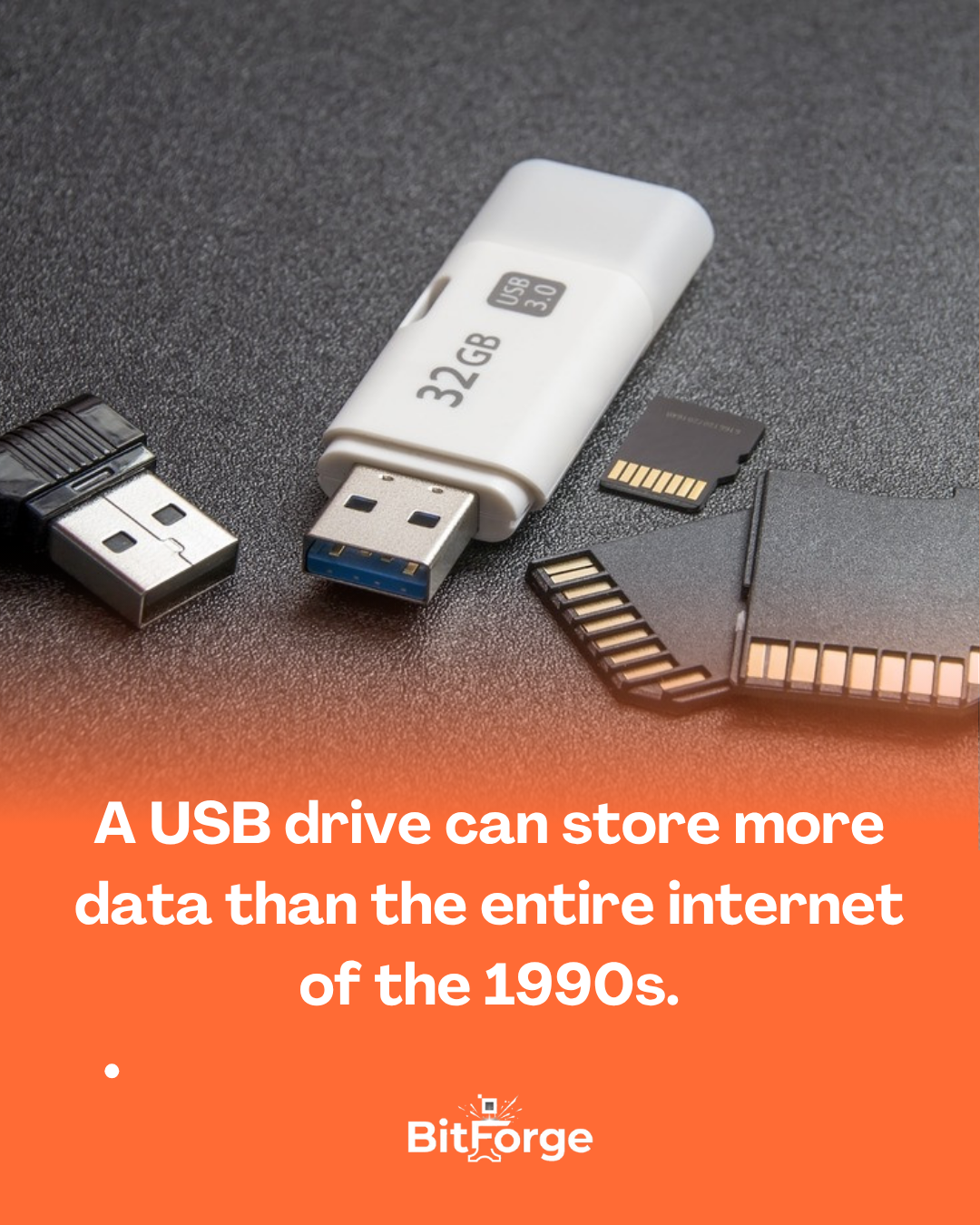

The evolution of digital storage is so astounding that it sometimes goes unnoticed. A curious example: a simple modern USB drive can store more data than the entire internet had in the 1990s.
In the mid-1990s, the internet was still relatively small. Estimates indicate that all the content available online in 1996 revolved around a few terabytes . At that time, pages were basically text, some small images, and small downloads—no streaming, social networks full of videos, or giant databases.
Now compare that to current technology.
Today it’s common to find flash drives with capacities of 128 GB, 256 GB, or even 1 TB that fit in your pocket. To give you an idea of the scale, 1 terabyte is equivalent to about 1,000 gigabytes , or more than 1 million megabytes of information.
In other words:
👉 A single modern USB drive can easily exceed the total amount of data that existed on the entire internet about 30 years ago .
This shows how technological advancement hasn’t just happened in computers or internet speed— storage has evolved on a gigantic scale . What once required entire servers can now literally fit on a keychain.
And the most curious thing is to think about the future:
If in just a few decades we went from an entire internet fitting on giant servers to fitting on a USB drive, what will fit on devices the size of a coin in the coming decades? 🚀
Frequently Asked Questions:
1. Is it true that a modern USB drive stores more data than the entire internet of the 1990s? It’s true, and the comparison is even more striking when the numbers are put side-by-side. Estimates from telecommunications researchers calculate that the total volume of data traveling over the internet in 1990 was approximately 1 terabyte per month—and this considers the entire global network, including universities, research centers, and the first commercial servers. A common USB drive sold in any computer store today for less than fifty reais permanently stores 2 terabytes of data. This means that an object smaller than a pinky finger, powered by a USB port, holds more information than everything that circulated on the entire global internet in a month in the early 1990s. The scale of this comparison is difficult to fully grasp.
2. What was the internet like in the 1990s in terms of size and capacity? The internet of the 1990s was a radically different environment from what we know today, both in size and nature. At the beginning of the decade, the network was used almost exclusively by universities, government agencies, and military research centers—home access was rare and expensive. Existing websites were simple text pages without images, videos, or any sophisticated visual elements. In 1993, when the Mosaic browser popularized graphical access to the web, there were about 130 websites worldwide. By 1995, that number had grown to about 23,000 websites—a number that today would be considered ridiculously small, since that many new websites are created in less than an hour in today’s world. The total bandwidth available on the global internet in the 1990s would be insufficient to stream a single HD movie by today’s standards.
3. How did the capacity of flash drives evolve so rapidly in just a few decades? The evolution of flash drives directly follows the advancement of NAND flash memory, the type of storage used in these devices. The first commercial flash drive, launched in 2000 by Trek Technology, had a capacity of 8 megabytes—enough to store a few text documents and nothing more. Twenty-six years later, 2 terabyte flash drives are available on the consumer market, representing a capacity increase of more than 250,000 times. This evolution was possible thanks to the constant miniaturization of memory cells, which allowed for stacking more and more storage layers in the same physical space. Technologies such as 3D NAND, which stacks memory layers vertically instead of just horizontally, have dramatically multiplied storage density without increasing the physical size of the component.
4. How much data does the internet move today compared to the 1990s? The difference is so great that the terms of measurement need to change completely to make sense. In the 1990s, total internet traffic was measured in terabytes per month. Today, the global internet moves more than 400 exabytes per month — and one exabyte is equivalent to one million terabytes. To make this comparison more concrete, the internet traffic of a single minute in 2026 far exceeds the total traffic of an entire month of the entire internet in the 1990s. This data explosion was driven primarily by streaming video, which today accounts for more than 80% of all global internet traffic, followed by video calls, online games, and the massive growth of connected devices such as cameras, sensors, and smart home appliances.
5. What fit on the internet in the 90s that easily fits on a flash drive today? Practically everything that existed digitally back then. Websites in the 90s were built with tiny text files—an entire page with all its content rarely exceeded a few kilobytes. Images were small, compressed to the maximum to load on dial-up connections that operated at speeds of 28 or 56 kilobits per second. Digital audio was rare and extremely compressed. Online video practically didn’t exist—the available bandwidth simply couldn’t handle video transmission in a practical way. All the textual content of the web in the mid-90s, including all publicly available websites, forums, discussion groups, and text files, would comfortably fit on a modern flash drive with room to spare for much more.
6. Why are digital files so much larger today than in the 1990s? The main reason is that the quality and richness of digital content have increased proportionally to the available storage and transmission capacity. In the 1990s, a digital photo had sufficient resolution only for viewing on small, low-resolution screens—files of a few kilobytes were considered normal. A photo taken by a modern smartphone at maximum resolution can be 50 megabytes or more. A one-minute video recorded in 4K occupies more space than all the content of many websites from the 1990s combined. Streaming music is transmitted in qualities that the original MP3 files of the 1990s couldn’t even approach. Content creation always expands to fill the available space and bandwidth—it’s a constant of technological evolution.
7. What would be the cost of storing the entire 1990s internet on modern hardware? It would be negligible by today’s standards—and this is perhaps the most striking comparison of all. The cost of storage per gigabyte has fallen from hundreds of dollars in the 1990s to fractions of a cent in 2026. Storing 1 terabyte of data—enough to hold the entire 1990s internet with space to spare—costs less today than a simple meal at any restaurant. In 1990, storing that same amount of data would have cost millions of dollars in specialized hardware, required an entire server room, and a dedicated maintenance team. The democratization of digital storage is one of the quietest and most profound economic transformations of recent decades, impacting absolutely every sector of society.
8. Are flash drives reliable for storing important data for a long time? They are reliable for regular use, but have important limitations for long-term storage that deserve attention. The flash memory used in flash drives has a defined lifespan in write and read cycles, and the stored data can degrade over time even without use—a process called data retention. Under ideal temperature and humidity conditions, a quality flash drive can keep data intact for ten years or more. But cheap flash drives of dubious quality can fail much sooner. For critical and long-term data storage, the professional recommendation is always to maintain multiple copies on different media—flash drive, external hard drive, and cloud storage—following the rule known as 3-2-1 backup, which ensures that the failure of any individual media does not result in permanent data loss.
9. What does this evolution in storage mean for the near future? It means that the capacity to store information will continue to grow in ways that seem exaggerated today, but which history shows to be completely plausible. If the evolution of the last few decades continues, flash drives with petabyte capacity—millions of gigabytes—could be a reality within a few decades. Emerging technologies such as synthetic DNA storage, which uses the molecular structure of DNA to store data at densities impossible for any conventional electronic media, promise to multiply this capacity even further. Researchers have already demonstrated that it is possible to store exabytes of data in a single gram of synthetic DNA—which would mean storing the entire current internet in an object smaller than a grain of sugar. What seems like science fiction today has a real probability of becoming commercial technology within a few decades.
10. What does this comparison between flash drives and the internet of the 1990s reveal about how we value technology? It reveals a universal human tendency to adapt quickly to technological improvements and forget how extraordinary they are. Someone who lived through the 1990s and used dial-up internet knows viscerally what it meant to wait minutes to load a single small image, pay by the hour for connection, and fight over the phone with family to get online. For those who grew up with fast internet and abundant storage, these limitations are abstract and difficult to imagine in practice. The comparison between a modern flash drive and the entire internet of the 1990s serves as a powerful reminder that we live in an era of unprecedented technological abundance—and that technologies that today seem slow or limited, such as internet connections in rural areas or entry-level smartphones, represent a power that previous generations of scientists and engineers could never have imagined available to ordinary people.