
If you follow technology, you’ve probably noticed one thing: gaming laptops are getting more and more powerful. And that raises a question that many people have today…
👉 Is it still worth building a desktop PC, or can a laptop already do everything?
The answer isn’t as simple as it seems. Let’s break this down as if we were chatting at a café table.
What has changed in gaming laptops?
Back in the day, gaming laptops were like an expensive “stopgap”: they could run games, but they overheated, were noisy, and lost performance quickly.
Today, the story is different.
Modern laptops have evolved in three main ways:
- Much more efficient video cards
- Smarter processors (use less energy)
- Best cooling system
In practice, this means that many laptops are already capable of running demanding games with excellent performance.
But do they already replace a desktop computer?
Here’s the key point:
👉 They replace… depending on their use.
Let’s compare them in a simple way:
🔹 Raw Performance
Even in 2026, the desktop is still the “king of the force”.
A PC with the same “parts” as a notebook usually delivers better performance. This is because:
- On a desktop, the components have more space.
- They heat up less.
- They work with more power.
👉 In other words:
A laptop might have a GPU with the same name as a desktop GPU, but it doesn’t deliver exactly the same performance.
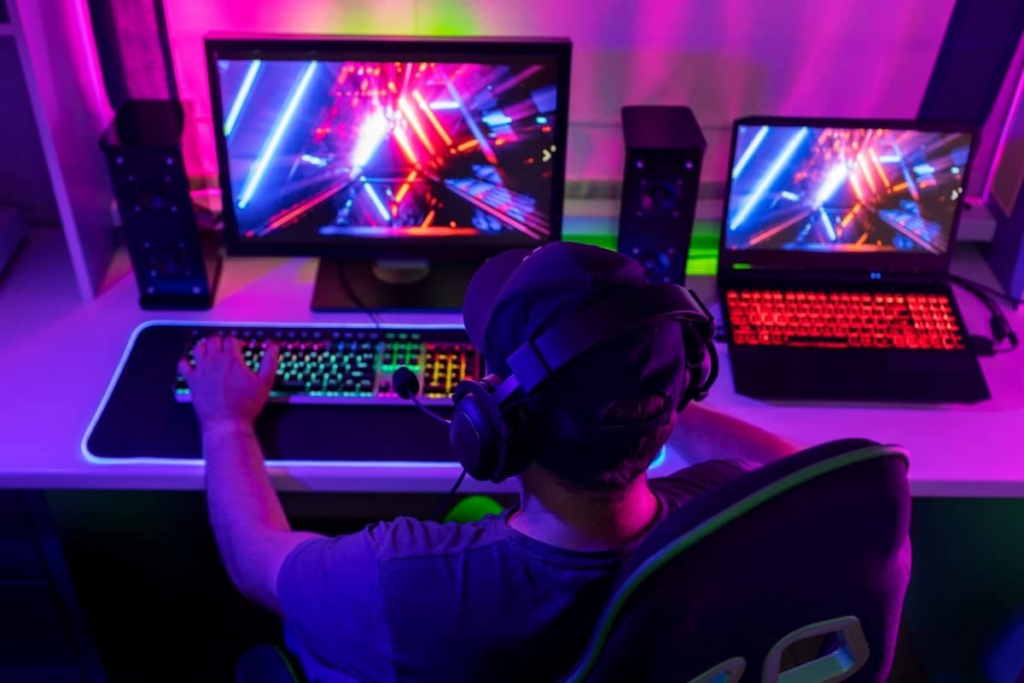
🔹 Portability (this is where the notebook crushes it)
This is the main reason for the rise of gaming laptops.
You can:
- Playing at the table
- Working at the college
- Take with you on trips
- Use anywhere
👉 The desktop, on the other hand, is practically a “fixed throne”.
If you need mobility, the notebook wins hands down.

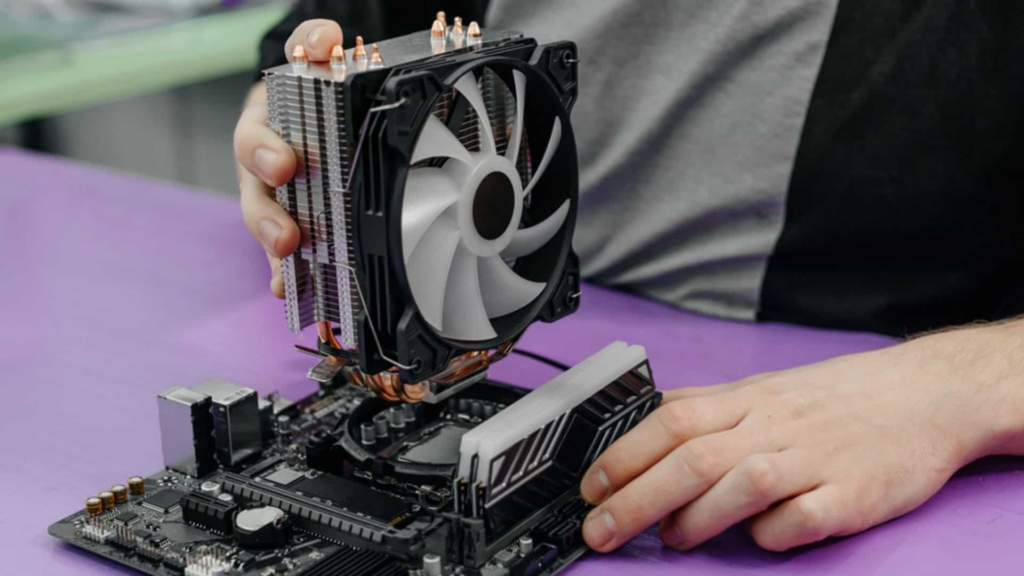
🔹 Upgrade (the weak point of the notebook)
This is a factor that many people ignore… until they need to.
On your desktop, you can:
- Replace video card
- Increase memory
- Upgrade the processor
- Change everything gradually.
On a laptop, you’re usually limited to:
- RAM
- SSD
👉 In other words: the notebook is more “closed”.
You buy it ready-made… and it ages along with time.
🔹 Cost-benefit
Here’s a straightforward truth:
👉 For the same price, a desktop computer usually delivers better performance.
This happens because on a laptop you are also paying for:
- Screen
- Battery
- Portability
- Compact engineering
The desktop, on the other hand, focuses solely on performance.
So why are laptops so popular?
Because the world has changed.
Today, many people:
- Work remotely
- Study online
- It moves more
- Want convenience?
And the gaming laptop has become a kind of “digital Swiss Army knife”:
👉 Play, work, edit, all in the same place.
For many people, this is worth sacrificing a little performance.
Practical examples
Let’s imagine two scenarios:
🧠 Person 1: Student + casual gamer
- You need to take your computer to college.
- Play at night
- Doesn’t want to mess with parts
👉 A gaming laptop makes perfect sense.
🧠 Person 2: Hardcore gamer / enthusiast
- Want maximum performance?
- Think about upgrades.
- Uses an external monitor, keyboard, and fixed setup.
👉 Desktop is still unbeatable.
What can we expect from here on out?
Laptops will continue to evolve, primarily in:
- Energy efficiency
- Cooling
- AI Integration
But there is a physical limit:
👉 A desktop computer will always have an advantage in raw power, simply because it doesn’t need to fit in a backpack.
Conclusion: Replacing or coexisting?
The most honest answer is:
👉 Gaming laptops aren’t completely replacing desktops… they’re sharing the market space with them.
- Want freedom and convenience? → Notebook
- Want maximum performance and upgrades? → Desktop
Today, there is no longer an “absolute best.” There is only what makes the most sense for your reality.
And perhaps that’s the biggest change of all:
Before, you had to adapt to the computer…
Now the computer adapts to you. 💻🔥
Frequently Asked Questions:
1. Can gaming laptops in 2026 really compete with desktops in performance?
The honest answer is: more than ever, but not yet completely. Modern gaming laptops have reached an impressive level of performance — processors with dozens of cores, high-performance dedicated graphics cards, and screens with very high refresh rates now fit into relatively thin and portable chassis. In everyday tasks, moderate video editing, and even demanding games, a current gaming laptop can deliver an experience very close to that of an equivalent-priced desktop. But when compared to desktops assembled with components of the same generation and price range, the desktop still consistently wins in raw performance, especially in long sessions of intense use.
2. Why do gaming laptops still lose out to desktops even with similar hardware?
The main culprit is heat. In a desktop case, components have ample space to breathe, large heatsinks, and multiple fans that efficiently move air. In a laptop, the same processor and graphics card must operate in an extremely compact space, with much smaller cooling solutions. To deal with this, manufacturers limit the energy consumption of the components—a process called configurable TDP—meaning that the GPU and CPU in a laptop operate at lower frequencies than the same parts in a desktop. The hardware is similar in name, but in practice, the laptop component is being intentionally limited to prevent the equipment from overheating.
3. Is a gaming laptop a good choice for someone who doesn’t need portability?
If the person will be using the equipment in a fixed location most of the time, a desktop remains the smarter choice financially. With the same budget as a mid-range gaming laptop, it’s possible to assemble a desktop with clearly superior performance, more RAM, larger storage, and a more powerful graphics card. Furthermore, a desktop can be upgraded piece by piece over the years—changing the GPU, adding RAM, or installing a faster SSD are simple operations. With a laptop, upgrade options are extremely limited, generally restricted to RAM and storage, while the processor and graphics card are soldered onto the motherboard and cannot be replaced.
4. Has the battery life of gaming laptops improved enough for everyday use?
It has improved significantly, but it’s still the Achilles’ heel of the category. In light use—browsing, documents, streaming—modern gaming laptops can last between four and six hours on a single charge, which is reasonable for casual use outside the home. The problem arises when the game starts: in gaming sessions with the GPU working at full load, battery life plummets to an hour or less in most models. This means that using a gaming laptop to play games away from a power outlet is, in practice, impractical for longer periods. Real portability exists for light tasks, but heavy gaming still ties the laptop to the power cord.
5. Do gaming laptops overheat to the point of hindering prolonged use?
This is a real problem that varies considerably between models and manufacturers. Laptops with poor thermal management can reach uncomfortable external temperatures on the keyboard and base during intense gaming sessions, in addition to causing the fans to spin at maximum speed, producing considerable noise. Thermal throttling—when the processor or GPU automatically reduces speed to prevent overheating—is more common in gaming laptops than manufacturers like to admit, especially in hot environments or after hours of continuous use. Using the laptop on surfaces that block air vents, such as a bed or sofa, greatly exacerbates this problem.
6. Is it worth paying more for a thin and light gaming laptop, or do more robust models offer better value?
Thin and light gaming laptops come at a high price for miniaturization. The engineering cost of fitting powerful hardware into a thin chassis with good thermal management is significant, and this cost is passed on to the consumer. With the same budget, a thicker and heavier gaming laptop from the same generation usually delivers better performance, more controlled temperatures, and sometimes superior screen and battery life. Choosing the thin model makes sense for those who actually carry the equipment every day and value the reduced weight—for mostly stationary use, the more robust models deliver more for less.
7. How do gaming laptop screens compare to desktop monitors in terms of image quality?
Gaming laptop screens have evolved significantly and now offer impressive options — panels with 240Hz, 360Hz, QHD resolution, wide color coverage, and very low response times. For portable use, these screens are excellent. But when connected to a quality external monitor, the laptop shows that the built-in screen still has limitations in terms of size, maximum brightness, and color reproduction compared to dedicated monitors in the same price range. Many gaming laptop users end up connecting an external monitor when they are at home, which in practice transforms the laptop into a portable desktop — a valid solution but one that raises the question of whether a conventional desktop wouldn’t be a better solution.
8. Is a gaming laptop a good option for someone who works and also wants to play games?
This is probably the situation where a gaming laptop makes the most sense. Professionals who need powerful equipment for work—developers, designers, video editors—and who also want to play games in their free time find in a gaming laptop a very competent compromise solution. Carrying a single device that meets both needs eliminates the need for a separate work laptop and a gaming desktop. In this specific scenario, the higher cost of a gaming laptop is justified by the consolidation of two needs into a single product.
9. Is the durability of gaming laptops comparable to that of desktops?
Generally, no. Laptops are subjected to more adverse conditions—transport, temperature variations, use on varied surfaces, and the mechanical stress of repeatedly opening and closing the chassis. The compact components and more limited cooling create a more stressful thermal environment, which can shorten the lifespan of components over time. Desktops, on the other hand, operate in a controlled environment, with easily replaceable components and much more space for air circulation. A well-assembled and reasonably well-maintained desktop can easily last ten years with occasional upgrades, while gaming laptops tend to show signs of aging more quickly with intensive use.
10. So, are gaming laptops really replacing desktops, or is that just marketing hype?
It’s a combination of both. Gaming laptops are undeniably more capable than ever and have carved out a real space in a market that previously belonged exclusively to desktops—especially among students, mobile professionals, and those living in small spaces where a full desktop setup isn’t feasible. Sales figures show consistent growth in the category. But complete replacement is still an exaggeration. For those who have space, don’t need portability, and want maximum performance at the lowest possible price, the desktop remains unbeatable in terms of cost-effectiveness, upgradeability, and longevity. The gaming laptop didn’t replace the desktop—it created and dominated its own segment for users with specific needs that a desktop simply cannot meet.