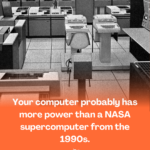
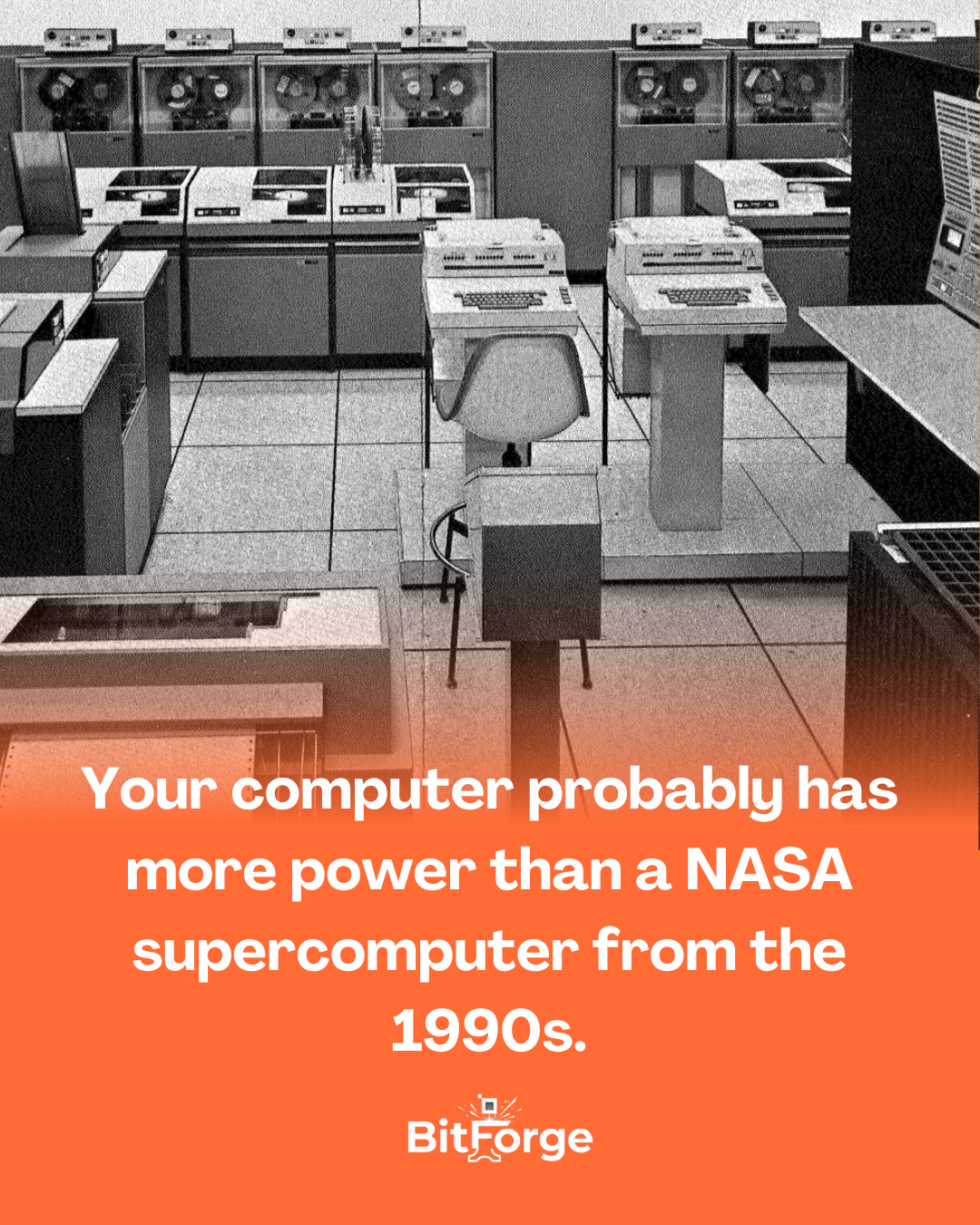

It may sound like an exaggeration, but there’s a good chance that the computer you use at home today is more powerful than some of the supercomputers used by NASA in the 1990s .
And no, this is not clickbait.
Let’s look at a real-world example.
In the 1990s, one of the systems used by NASA and research centers was based on the original Intel Pentium , released in 1993. These processors had a clock speed of around 60 to 66 MHz and could execute approximately 100 million instructions per second .
At the time, this was considered extremely advanced.
Today, even a regular computer can have something like:
- 3 to 5 GHz processor
- 6, 8 or more cores
- billions of instructions per second
- GPUs capable of performing trillions of calculations.
To give you an idea, a modern GPU like those in the RTX line can reach tens of teraflops of computing power .
In the 1990s, an entire supercomputer often barely came close to that.
I.e:
📌 A single modern gaming PC can outperform, in certain types of calculations, giant machines that occupied entire rooms 30 years ago.
But then why did NASA need supercomputers?
Because back then, processors that were individually powerful didn’t exist .
To simulate weather, space orbits, or aircraft designs, they connected hundreds or thousands of CPUs working together .
Today, much of that capacity has been miniaturized thanks to decades of evolution in:
- chip lithography
- parallelism in GPUs
- multicore architectures
- much faster memory
The evolution was absurd.
Between 1990 and today, computing power has increased millions of times .
This means that things that previously required giant laboratories can now run at home, such as:
- physical simulations
- 3D rendering
- artificial intelligence
- 4K video editing
- games with real-time ray tracing
The most curious thing of all
Despite all this progress, many people use computers that are more powerful than the machines that helped plan space missions…
…just to open 30 Chrome tabs and watch YouTube videos.
And honestly?
This already says a lot about how much technology has evolved.
Frequently Asked Questions:
1. Is it true that modern home computers outperform old NASA supercomputers? Yes, it is, and the magnitude of that difference is even more impressive than the statement suggests. The Intel Paragon, one of the most powerful supercomputers of the early 1990s, occupied the space of a tennis court, consumed enough energy to power hundreds of homes, and cost tens of millions of dollars. A mid-range smartphone from 2026 surpasses that machine in pure processing speed. A modern home PC with a state-of-the-art processor not only surpasses—it crushes—the computing power of machines that cost fortunes and required entire teams of engineers to operate and maintain. We are living in an era of unprecedented computing power in human history, and most people use that power to watch videos and browse social media.
2. What was a NASA supercomputer like in the 1990s in practice? NASA supercomputers in the 1990s were monumental machines in every sense. The Cray Y-MP, widely used by agencies like NASA in the early part of the decade, weighed tons, occupied entire rooms with dedicated cooling systems, and operated at speeds measured in gigaflops—billions of floating-point operations per second. These machines required reinforced floors, dedicated electrical power systems, and teams of dozens of specialized technicians working in shifts to keep them running. Access was extremely restricted and controlled—scientists had to schedule usage time in advance, like reserving an operating room. The idea that any ordinary person could have access to this computing power was considered pure science fiction at the time.
3. What numbers prove this comparison between modern PCs and older supercomputers? The numbers are concrete and verifiable. The Cray-2, considered the world’s fastest supercomputer in 1985, reached about 1.9 gigaflops of peak performance. A modern entry-level home processor easily operates in the teraflop range—that is, a thousand times more operations per second. A modern mid-range gaming video card delivers more than 10 teraflops, which is equivalent to more than five thousand times the power of the Cray-2. The world’s fastest supercomputer in 1993—the Thinking Machines CM-5, used by NASA and other scientific centers—would be considered absurdly slow compared to any PC assembled today with components bought in any computer store.
4. Why has the evolution of computers been so rapid in just a few decades? The answer lies in a concept called Moore’s Law, formulated in 1965 by Intel co-founder Gordon Moore. He observed that the number of transistors on a silicon chip doubled approximately every two years, while maintaining or reducing the cost of production. This constant doubling of capacity resulted in an exponential growth curve that completely transformed electronics in just a few decades. Transistors that in the 1970s measured several micrometers are now manufactured on the scale of a few nanometers—to give you an idea, a human hair is about 80,000 nanometers thick, while modern transistors measure less than 3 nanometers. This miniaturization has allowed billions of transistors to be placed on a chip the size of a fingernail, multiplying computing power in a way that no other technological sector has been able to replicate.
5. Does this comparison only apply to processors, or have other components evolved as much as well? All components have evolved equally impressively, and in some cases even more so. The RAM in a modern home PC operates at speeds that were unimaginable for the memory systems of 1990s supercomputers. Storage systems have evolved even more dramatically—a modern NVMe SSD transfers data at speeds that 1990s storage systems could never achieve, occupying less space than a deck of cards. Graphics capabilities are perhaps the most visible evolution—real-time graphics rendered by any modern console or gaming PC surpass in quality and speed the best scientific rendering systems available in the 1990s, which took hours to process simple images per computer.
6. How did NASA use these supercomputers, and what were they capable of at the time? NASA’s supercomputers in the 1990s were primarily used for extremely complex mathematical simulations—modeling the behavior of fluids around spacecraft, trajectory calculations for space missions, climate simulations, and data analysis from telescopes and space probes. Tasks that today a simulation software runs in minutes on a home PC could take days or weeks on these machines. Processing images from the Hubble Telescope, launched in 1990, required massive computational infrastructure for image analysis and correction. The irony is that the algorithms and mathematical techniques developed by NASA scientists at that time to extract the maximum from these limited machines laid the foundation for much of the scientific software used to this day.
7. Does a current smartphone also outperform older supercomputers? Yes, and by a wide margin. The processor in a current mid-range smartphone processes billions of operations per second, has access to gigabytes of high-speed RAM, and runs a complete operating system with sophisticated multitasking capabilities—all in a device that fits in your pocket and runs on a small battery for hours. The Connection Machine CM-5 supercomputer, used by NASA and other agencies in the 1990s, occupied an entire room, consumed megawatts of power, and required industrial cooling to operate. The smartphone processor not only surpasses this equipment in raw speed—it does so while consuming a tiny fraction of the energy, without the need for special cooling, and at a cost that is billions of times lower proportionally.
8. Why do supercomputers still exist if ordinary PCs are so powerful? Because the problems that modern supercomputers solve have scaled in proportion to the available computing power. Detailed global climate simulations, protein modeling for drug development, nuclear explosion simulations, high-resolution weather forecasting, and training large-scale artificial intelligence models require computing power far beyond what any home PC can deliver. Modern supercomputers like Frontier, launched in 2022, operate at the exaflop scale—quintillions of operations per second—and yet scientists are often left waiting in line for processing time. The demand for computing power always grows to fill the available capacity, regardless of how much that capacity increases.
9. Will this evolution continue at the same pace, or are we reaching a physical limit? We are reaching real physical limits, and the industry has been dealing with this for some years now. The miniaturization of transistors is approaching barriers where the effects of quantum physics begin to interfere with the functioning of chips—transistors so small that electrons can “jump” through them even when they should be blocked, causing errors. Moore’s Law in its original form is losing validity. The industry’s response has been to innovate in other dimensions—chips with multiple cores, vertically stacked architectures in three dimensions, processors specialized for specific tasks such as artificial intelligence, and the emerging development of quantum computing. Evolution will continue, but along different paths than the last fifty years.
10. What does this comparison tell us about how we use the computing power we have today? It tells us that most people monumentally underutilize the equipment they have at their disposal. A modern home PC has enough power for scientific simulations that would have required government budgets thirty years ago, and most of the time it sits idle waiting for the next mouse click or the next video to load. This isn’t necessarily a problem—it’s actually a sign of how much technology has become more democratized and cheaper. But it’s an invitation to reflect on what is possible to do with this accessible power. Content creators, musicians, independent game developers, amateur scientists, and digital entrepreneurs have access today to computing tools that entire organizations couldn’t dream of having a few decades ago. The limitation today is rarely the hardware—it’s the imagination and knowledge of how to leverage it.